
Symptoms
The symptoms that occur are often not immediately recognised as myasthenia gravis. The degree of muscle weakness involved in MG varies greatly amongst patients.
It ranges from a localised form (limited to eye muscles) to a severe generalised form (involving muscles that control breathing).
Symptoms vary amongst patients but there are some commonalities:
- Weakness of the eye muscles causing ptosis (droopy eyelids) or diplopia (double vision)
- Difficulty in swallowing
- Shortness of breath
- Slurred or impaired speech (dysarthria)
- Unstable or waddling gait
- Weakness in arms, hands, fingers, legs and neck.
Image Courtesy of
https://www.flickr.com/photos/nataliejohnson/2055440225/
under a creative commons licience
Muscle weakness typically worsens as the muscle is used. Most patients feel that rest improves the muscle strength, but this is not always the case. Sensation is normal is MG patients. When patients have severe weakness that does not respond to treatment, a constant state of weakness may be developed.
Muscle shrinking (atrophy) is not part of Myasthenia Gravis, but some patients with severe weakness for many years can have some atrophy (muscle 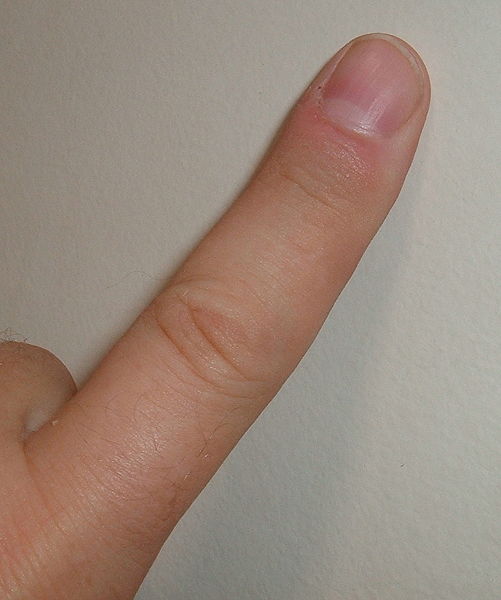 wasting). Sometimes, patients may only experience symptoms in the leg, but doctors can perform tests to see if there is weakness in other areas of the body.
It is unlikely for MG to be present only in one area, such as a leg, and not be present elsewhere in the body. Myasthenia Gravis does not produce loss of coordination, except as related to weakness. Myasthenia Gravis can produce isolated finger weakness.
Image Courtesy of
https://commons.wikimedia.org/wiki/Image:Finger.agr.jpg
This image is in the public domain and thus free of any copyright restrictions.

Contact
Search site
Did you know...
Thomas Willis (1621-1675) an English physician, published a book, De anima brutorum in 1672 in which he wrote about "a woman who temporarily lost her power of speech and became 'mute as a fish.'". This has been interpreted as being the first written description of myasthenia gravis.